


Introduction
Every so often, a weird concept crosses my path and I can only sit and wonder as to why a certain method or technology works the way it does, or doesn’t work the way I want it to work. A string enumeration is such a case. Now look, I am not the tastiest sweet in the pack, but some things I find hard to fathom at first, but then I go back to some of my old books and realize that I am yet again attempting to break the very rules of a language that makes the language work. Today, I will show you a quick way to make an Enum accept String values instead of an ordinary named constant.
Enums
An Enum is a list of named constants that, well, provides a list of options. These options could be a list of settings or whatever you decide it be, except for a list of strings that actually contain spaces. A list of other data types and structures can be found here.
Let’s Create a Small Project
Create a new Visual Basic Windows Forms project. Once the form displays, add a big TextBox and one Button. Before we start with the form’s code, add a new Class. This class will host the capabilities to create our String Enum. I have named my class StringEnum.
Add the following Namespace:
Imports System.Reflection
Directly quoted from MSDN: The System.Reflection namespace contains types that retrieve information about assemblies, modules, members, parameters, and other entities in managed code by examining their metadata.
Add the following to add the StringValue class and give it a property named Value:
Public Class StringValue

   Inherits System.Attribute

   Private ReadOnly _value As String

   Public Sub New(value As String)

      _value = value

   End Sub

   Public ReadOnly Property Value() As String

      Get

         Return _value

      End Get

   End Property

End Class
Straightforward. The class is created. It is given a Constructor and a Property named Value. Now, let’s get complicated! Add another class and name it StringEnum.
Public NotInheritable Class StringEnum

   Private Sub New()

   End Sub

   Public Shared Function GetStringValue(value As [Enum]) As String

      Dim output As String = Nothing

      Dim type As Type = value.[GetType]()

      Dim fi As FieldInfo = type.GetField(value.ToString())

      Dim attrs As StringValue() = _
         TryCast(fi.GetCustomAttributes(GetType(StringValue), _
         False), StringValue())

      If attrs.Length > 0 Then

         output = attrs(0).Value

      End If

      Return output

   End Function

End Class
The StringEnum class creates a Type object that depends on the value that gets supplied to this class. Then, it creates a FieldInfo object that converts the supplied value Type to a string with the help of the StringValue class.
Add the following code to create an Enum capable of hosting string values:
Public Enum GameColorModes

   <StringValue("Black")> _
   Black = 1
   <StringValue("Green")> _
   Green = 2
   <StringValue("Blue")> _
   Blue = 3
   <StringValue("Red")> _
   Red = 4
   <StringValue("White")> _
   White = 5

End Enum
There you go! Voilà. Now, let’s put this Enum to good use. Add the following Function to your Form:
   Private Function GetColorCodes(intColor As Integer) As String

      Dim strColorDesc As String = ""

      Select Case DirectCast(intColor, GameColorModes)

         Case GameColorModes.White

            strColorDesc = StringEnum.GetStringValue(GameColorModes.White)

            Exit Select

         Case GameColorModes.Blue

            strColorDesc = StringEnum.GetStringValue(GameColorModes.Blue)

            Exit Select

         Case GameColorModes.Green

            strColorDesc = StringEnum.GetStringValue(GameColorModes.Green)

            Exit Select

         Case GameColorModes.Red

            strColorDesc = StringEnum.GetStringValue(GameColorModes.Red)

            Exit Select

         Case GameColorModes.Black

            strColorDesc = StringEnum.GetStringValue(GameColorModes.Black)

            Exit Select

         Case Else

            strColorDesc = "Undefined"

            Exit Select

      End Select

      Return strColorDesc

   End Function
This function determines what value has been sent through, and then converts the received value to the Enum’s value. Lastly, it stores the Enum’s value into a string variable named strColorDesc. Add the last piece of the puzzle:
   Private Sub Button1_Click(sender As Object, e As EventArgs) _
      Handles Button1.Click

      TextBox1.Text += GetColorCodes(1) & Environment.NewLine
      TextBox1.Text += GetColorCodes(2) & Environment.NewLine
      TextBox1.Text += GetColorCodes(3) & Environment.NewLine
      TextBox1.Text += GetColorCodes(4) & Environment.NewLine
      TextBox1.Text += GetColorCodes(5) & Environment.NewLine
      TextBox1.Text += GetColorCodes(6) & Environment.NewLine

   End Sub
Once run, the application will resemble Figure 1.
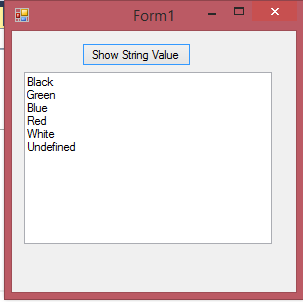
Figure 1: The String Enum in action
Conclusion
Giving enumerations the capability to host String values was a bit complicated, yes, but it is worth it. You will make use of this feature many-a-time. Until next time, cheers!