I was working with a small project where we had the task to identify raw
input devices attached to the system. We also needed to retrieve the attached
raw input device informations in detail. I found few online articles and APIs on
MSDN which proved to be very useful in completing the task assigned to me.
In this article I am going to explain and demonstrate the usage of these RAW
Input APIs. As a additional reference I strongly recommend the MSDN article( RAW INPUT ). In the example chosen, I have used two
Win32 APIs to enumerate the attached raw input devices, each device name and
device informations. The following section describes two Win32 APIs briefly.
UINT GetRawInputDeviceList( PRAWINPUTDEVICELIST pRawInputDeviceList,
                            PUINT puiNumDevices,
                            UINT cbSize);
This function is used for enumeration of raw input devices. For full description please follow MSDN article ( GetRawInputDeviceList ).
UINT GetRawInputDeviceInfo( HANDLE hDevice,
                            UINT uiCommand,
                            LPVOID pData,
                            PUINT pcbSize);
To get detailed information about the attached devices, use the GetRawInputDeviceInfo function. The following demo code snippet is the implemenation details to get attached raw input devices name and information:
// HIDDeviceCheck.cpp : Defines the entry point for the console application.
//
#include “stdafx.h”
#include “HIDDeviceCheck.h”
#ifdef _DEBUG
#define new DEBUG_NEW
#endif
// The one and only application object
CWinApp theApp;
using namespace std;
int _tmain(int argc, TCHAR* argv[], TCHAR* envp[])
{
   int nRetCode = 0;
   // initialize MFC and print and error on failure
   if (!AfxWinInit(::GetModuleHandle(NULL), NULL, ::GetCommandLine(), 0))
   {
      // TODO: change error code to suit your needs
      _tprintf(_T(“Fatal Error: MFC initialization failed\n”));
      nRetCode = 1;
   }
   else
   {
      // TODO: code your application’s behavior here.
      UINT nDevices;
      PRAWINPUTDEVICELIST pRawInputDeviceList;
      if (GetRawInputDeviceList(NULL, &nDevices, sizeof(RAWINPUTDEVICELIST)) != 0)
      {
         cout << “Errors…” << endl;
         return 1;
      }
      if ((pRawInputDeviceList = (PRAWINPUTDEVICELIST)malloc(sizeof(RAWINPUTDEVICELIST) * nDevices)) == NULL)
      {
         cout << “Initialization failed…” << endl;
         return 1;
      }
      int nNoOfDevices = 0;
      if ((nNoOfDevices = GetRawInputDeviceList(pRawInputDeviceList, &nDevices, sizeof(RAWINPUTDEVICELIST))) == ((UINT) – 1))
      {
         // Error
         return 1;
      }
      RID_DEVICE_INFO rdi;
      rdi.cbSize = sizeof(RID_DEVICE_INFO);
      for(int i = 0; i < nNoOfDevices; i++)
      {
         UINT size = 256;
         TCHAR tBuffer[256] = {0};
         if(GetRawInputDeviceInfo(pRawInputDeviceList[i].hDevice, RIDI_DEVICENAME, tBuffer, &size) < 0)
         {
            // Error in reading device name
         }
         // cout << “Device Name: ” << tBuffer << endl;
         _tprintf(L”Device Name: %s\n”, tBuffer);
         UINT cbSize = rdi.cbSize;
         if(GetRawInputDeviceInfo(pRawInputDeviceList[i].hDevice, RIDI_DEVICEINFO, &rdi, &cbSize) < 0)
         {
            // Error in reading information
         }
         if(rdi.dwType == RIM_TYPEMOUSE)
         {
            cout << “ID for Mouse:” << rdi.mouse.dwId << endl;
            cout << “Number of Buttons:” << rdi.mouse.dwNumberOfButtons << endl;
            cout << “Sample rate(Number of data points):” << rdi.mouse.dwSampleRate << endl;
            cout << “**************************” << endl;
         }
         if(rdi.dwType == RIM_TYPEKEYBOARD)
         {
            cout << “Keyboard Mode:” << rdi.keyboard.dwKeyboardMode << endl;
            cout << “Number of function keys:” << rdi.keyboard.dwNumberOfFunctionKeys << endl;
            cout << “Number of indicators:” << rdi.keyboard.dwNumberOfIndicators << endl;
            cout << “Number of keys total: ” << rdi.keyboard.dwNumberOfKeysTotal << endl;
            cout << “Type of the keyboard: ” << rdi.keyboard.dwType << endl;
            cout << “Subtype of the keyboard: ” << rdi.keyboard.dwSubType << endl;
            cout << “***********************” << endl;
         }
         if(rdi.dwType == RIM_TYPEHID)
         {
            cout << “Vendor Id:” << rdi.hid.dwVendorId << endl;
            cout << “Product Id:” << rdi.hid.dwProductId << endl;
            cout << “Version No:” << rdi.hid.dwVersionNumber << endl;
            cout << “Usage for the device: ” << rdi.hid.usUsage << endl;
            cout << “Usage Page for the device: ” << rdi.hid.usUsagePage << endl;
            cout << “***********************” << endl;
         }
      }
      free(pRawInputDeviceList);
   }
   return nRetCode;
}
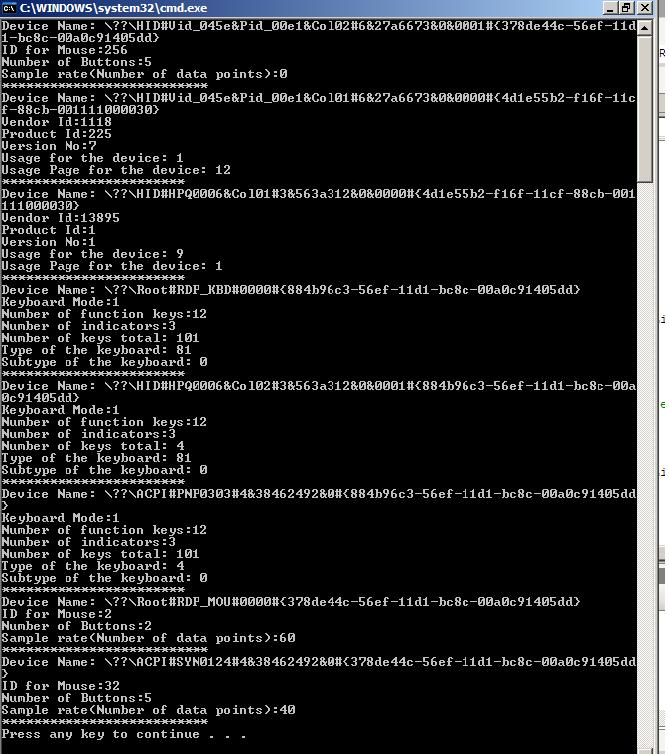
The snap shot of the output looks like the picture below: